


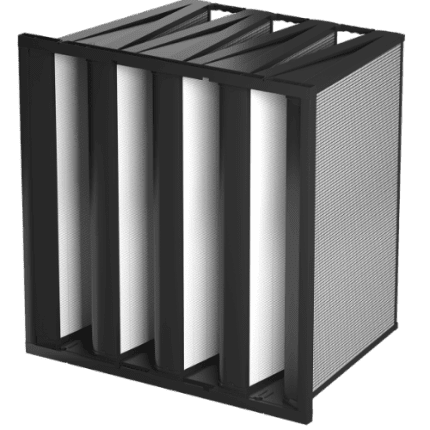
In practical air filtration stages, systems usually start with a pleated filter and then move to a secondary filter or final filter like pocket bag air filters, bag air filters, bag filters, or pocket filters. In my experience working around HVAC filtration systems, these F5–F9 bag filter media pockets and bag filter media pockets play an important role in maintaining stable air filtration performance inside HVAC systems, cleanrooms, and industrial air handling units. These high-efficiency filter elements installed in air handling units and AHUs provide consistent particle filtration, reliable filtration, and strong air quality management while protecting downstream filters and improving overall filter life and extended filter life. The design of filtration media pockets, bag pockets, and pocket filter media improves filtration efficiency, reduces low resistance, and supports low pressure drop, allowing smooth energy-efficient operation, strong airflow efficiency, and stable HVAC energy efficiency across many industrial filtration systems and cleanroom filtration environments.
Most pocket air filters, including F5–F9 bag filter, medium efficiency bag filter, HVAC bag filter, industrial bag filter, and synthetic bag filter, are built using synthetic fiber media, micro-glass fiber media, synthetic fiber, micro glass fiber, or glass fiber media as the core filtration fiber material and filter media material. The internal pocket filter structure is created from filter media pieces forming sealed media pockets through careful pocket filter construction, usually reinforced with thermally bonded seams, bonded seams, and sealed filter seams for strong leakage prevention and air leakage protection. These bag filter pocket air filters are available with multiple pocket lengths, pocket numbers, variable pocket sizes, and configurations like 3 pocket bag filter or 6 pocket bag filter, creating different surface area sizes and larger surface area which improves dust-holding capacity, high dust holding capacity, dust holding capacity DHC, DHC, service life extension, extended service life, long service life, filter durability, filtration lifespan, and air filter longevity. Performance is classified under efficiency class F5–F9, including efficiency class F5, efficiency class F6, efficiency class F7, efficiency class F8, and efficiency class F9, aligned with filtration classification, filter efficiency rating, and international air filtration standards such as EN 779, EN 779 standard, ISO 16890, ISO 16890 standard, ISO ePM10, ISO ePM1, GMP standards, filtration compliance standards, air filter regulatory standards, and manufacturing compliance. Structurally, a strong filter frame material like galvanised steel, aluminium profile, stainless steel, or plastic frame supports the filter specifications and air filter technical specifications, while uniform pocket shape, maximum air flow, minimum resistance, and high-strength mechanical staking help secure pockets and prevent pocket separation under high turbulent conditions or turbulent airflow conditions. Because of this stability and filter surface area design, these medium efficiency bag filter pocket air filters are often a preferred option for fly ash applications, especially where fly ash filtration is needed and equipment must remain simple to operate with easy operation. In different production environments, filter color coding like orange, green, pink, yellow, and white may be used, while temperature performance may reach maximum temperature limits of 93ºC, ensuring good temperature resistance and high temperature tolerance. Standards such as EN779 2012, ASHRAE 52.2-2007, fiber class, fiber class ASHRAE, filtration fiber classification, MERV rating system, MERV 5, MERV 8, MERV 11, MERV 13, MERV 14, MERV 15, G3, G4, F5, F6, F7, F8, and F9 further guide how these pocket bag filters, air filter pockets, and ventilation filtration systems perform across modern industrial air handling and cleanroom air handling installations.
| Product Name | F5–F9 Bag Filter Media Pockets |
| Efficiency | F5–F9 (EN 779) / ISO ePM10–ePM1 (ISO 16890) |
| Material | Synthetic fiber / Micro-glass fiber |
| Design | Thermally bonded seams, leak-proof pockets |
| Pocket Options | Multiple pocket lengths and numbers |
| Dust Holding Capacity | High, extended filter service life |
| Airflow Resistance | Low pressure drop, energy-efficient |
| Compliance | EN 779, ISO 16890, GMP |
| Applications | HVAC systems, AHUs, cleanrooms, pharmaceuticals, food industry, electronics |
What is an F9 grade filter?
According to EN 779 standards, an F9 filter is considered a high-efficiency air filter. In the North American rating system, it is roughly equal to a MERV 15 filter. Under the ISO 16890 standard, it usually has a rating of ePM1 80%, which means it can remove about 80% of very small airborne particles that are smaller than 1 micron.
What is F9 filtration?
The F9 cassette filter is made to capture very fine particles and contaminants from the air, especially those smaller than 1 micrometre (ePM1). While it is not a HEPA filter, it is still a reliable option for removing fine dust in many workplaces and indoor environments.
Reviews
There are no reviews yet.